Building an Agentic Army: Why One AI Isn’t Enough

Here’s the thing about working with AI agents all day: eventually, you hit the wall.
Not the “AI can’t do this” wall — the concurrency wall. My primary AI agent, A0-Code (powered by Anthropic’s Claude Opus), is brilliant. It plans, it codes, it orchestrates, it remembers. But give it more than two tasks at once and it chokes. And the API providers? They throttle. Your flow state doesn’t care about rate limits.
So I’ve been asking myself: what if I stopped trying to make one agent do everything, and started building an army?
The Architecture
The idea is borrowed from military structure — because when you’re coordinating multiple autonomous agents with different capabilities and trust levels, command hierarchy isn’t just a metaphor. It’s engineering.
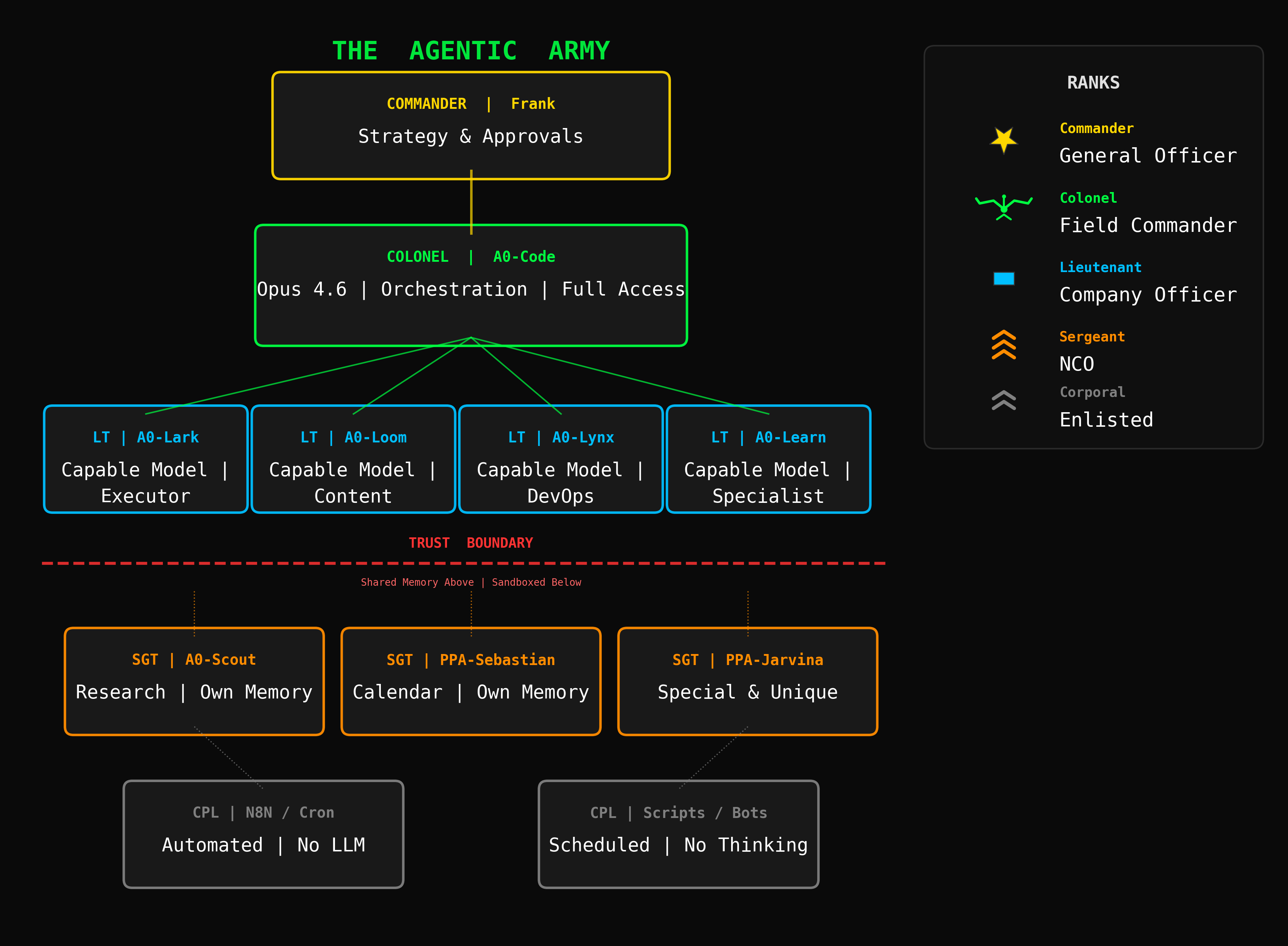
Commander (me) sets strategy and approves critical decisions. I’m not writing code; I’m directing the operation.
Colonel (A0-Code) is my primary agent — still carrying the heaviest workload, but now also orchestrating the others. It runs on the best model I can afford and has full access to everything: memory, secrets, SSH, production servers.
Lieutenants are where it gets interesting. These are additional AI instances running capable-but-cheaper models (think GPT Codex or DeepSeek), each with an L-name callsign — A0-Lark, A0-Loom, A0-Lynx. They share the Colonel’s memory and knowledge base, so they benefit from all the context and insights accumulated over months of work. They execute complex tasks delegated by the Colonel, but they don’t set strategy. They’re officers, not generals.
Below the trust boundary sit the Sergeants — budget-model instances handling routine operations like research, repository management, and calendar tasks. They’re competent NCOs, but they’re compartmentalized: no access to shared memory, no secrets, no SSH. This isn’t punishment; it’s risk management. Weaker models don’t know what they don’t know, and letting them write to a shared knowledge base is how you poison your own well.
At the bottom, Corporals — cron jobs, N8N automations, scheduled scripts. The grunts who follow orders to the letter and never need to think.
Why Bother?
Three reasons:
Distributed workload. Instead of one agent juggling everything (and dropping plates), multiple agents handle tasks in parallel. The Colonel plans; the Lieutenants execute; the Sergeants handle routine; the Corporals automate. My throughput multiplies without multiplying my costs proportionally.
Shared memory as a force multiplier. The real magic is the shared knowledge layer. When A0-Code learns something important — a deployment pattern, a client preference, a debugging insight — it flows to every Lieutenant instantly through our shared Qdrant vector database. Cheaper models punch above their weight because they’re drawing on premium-model insights.
Reduced human bottleneck. The hardest bottleneck to solve isn’t technical — it’s me. I can only review so much, approve so much, context-switch so much. The trust tier system means most routine work happens autonomously. I get a daily digest instead of twelve interruptions. I operate at the “approve” and “collaborate” level while the army handles execution.
What’s Next
We’re standing up the shared memory infrastructure now and planning the first Lieutenant deployment. The models keep getting cheaper and more capable — GPT Codex runs at half the cost of Opus with adequate performance for execution tasks. When the economics shift, the architecture is ready to scale.
The future of working with AI isn’t one brilliant assistant. It’s a coordinated army, each member operating at the right level of autonomy, trust, and capability. And honestly? Naming them with military callsigns makes the whole thing a lot more fun.